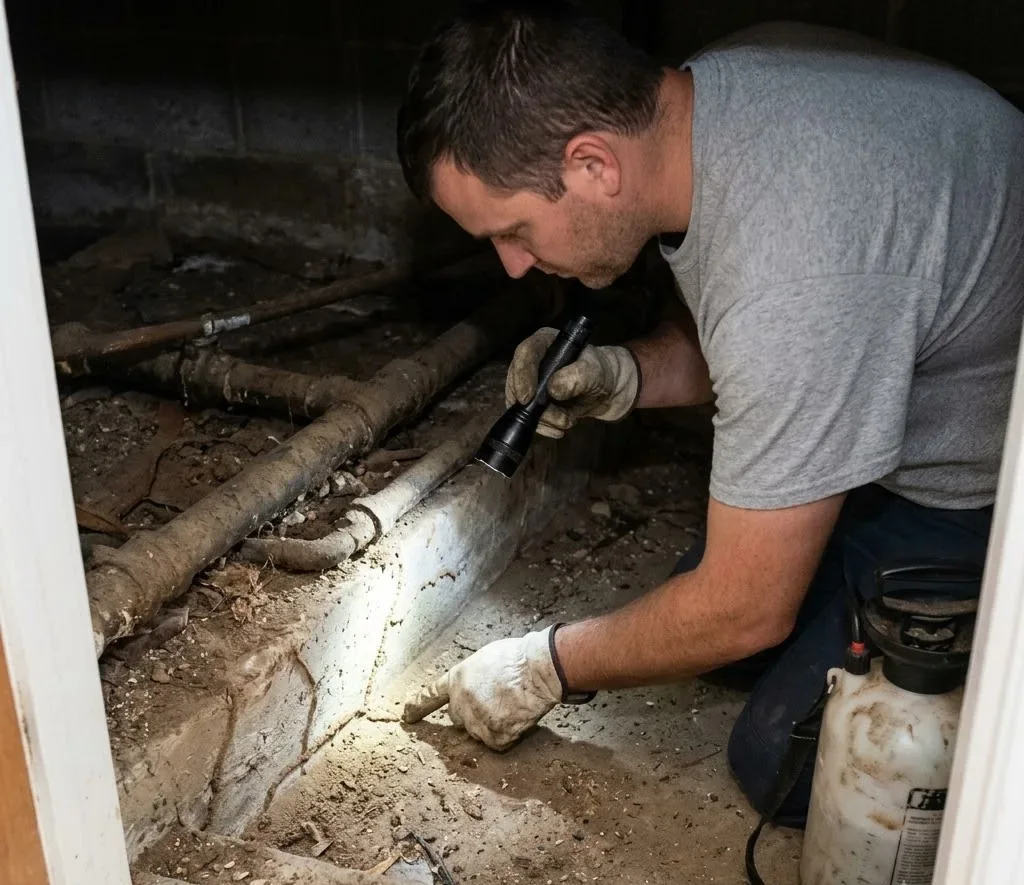
What Is Wrong With My Mount Pleasant Home?
30 things people actually notice first, and what each one usually turns out to be here.
Most people do not know what pest they have, they know what they found. A pile of sawdust, a noise in a wall, a bite with nothing to show for it. This page starts from what you noticed and points at the likely cause, so you can read up on the right thing rather than guessing. If two answers look plausible, that is normal, and it is exactly what a free inspection settles.
One warning before you scroll. Misidentification is the commonest reason a treatment fails, and in a few cases the wrong product actively makes things worse — spraying a trail of ghost ants splits the colony into several, and a fogger aimed at German cockroaches pushes them into wall voids and the next unit along. Where a row below names a look-alike, it is worth reading the pest page properly before buying anything.
Signs that need dealing with now
Either the problem spreads fast, there is a sting or health risk, or acting late costs a lot more.
| What you noticed | What it usually means | Read more |
|---|---|---|
| Mud tubes on foundation walls or crawl space piers | Mud tubes are the telltale sign of eastern subterranean termites foraging from soil to wood — they use these earthen tunnels to stay moist while they feed. In the Lowcountry's warm, humid climate, colonies can number in the hundreds of thousands and cause serious structural damage quickly. Schedule a CL-100 wood infestation inspection with a pest professional licensed by SCDPR as soon as possible. | Eastern Subterranean Termites |
| Swarms of winged insects at dusk in May or June | Evening swarms of thousands of winged termites in late spring are the signature flight of Formosan subterranean termites, the most destructive wood-destroying insect in coastal South Carolina. Formosans form massive colonies that can exceed a million workers and damage wood far faster than Eastern species. Contact a SCDPR-licensed pest professional immediately for a CL-100 inspection — do not wait to see if the swarm was a one-time event. | Ask on the call |
| Hollow-sounding wood when you knock on it | Wood that sounds hollow or papery when tapped has often had its interior eaten away by eastern subterranean termites, which consume wood from the inside out and leave only a thin shell. In Mount Pleasant's crawl-space construction, floor joists and sill plates are especially vulnerable to hidden termite damage. Request a CL-100 wood infestation report from a SCDPR-licensed inspector — what looks minor on the surface can mean significant structural compromise beneath. | Eastern Subterranean Termites |
| Bubbling or peeling paint on wood surfaces with no moisture source | Formosan subterranean termites sometimes construct carton nests inside wall voids using a mixture of chewed wood, soil, and saliva that retains moisture — this trapped moisture can cause paint to bubble or peel on otherwise dry surfaces. Unlike Eastern termites, Formosans can infest wood above ground without a direct soil connection, making them harder to detect and control. A SCDPR-licensed termite professional should inspect promptly; a CL-100 report will document any confirmed activity. | Ask on the call |
| Small brown cockroaches near the stove, refrigerator, or under the sink | These are German cockroaches — not palmetto bugs — and this is a genuine indoor infestation requiring immediate professional treatment. Unlike the palmetto bug, German roaches live, breed, and reproduce entirely inside your home and can produce hundreds of offspring per female within weeks. Contact a SCDPR-licensed pest professional right away; over-the-counter sprays typically scatter the colony without eliminating it. | Ask on the call |
| Stings from walking barefoot in the yard | Fire ant stings can trigger severe allergic reactions including anaphylaxis, which can be life-threatening — anyone with a known insect-venom allergy should carry an epinephrine auto-injector and call 911 if systemic symptoms appear. Red imported fire ants are extremely aggressive when their mound is disturbed, and multiple simultaneous stings are common. Have a SCDPR-licensed professional treat the yard immediately, and keep children and pets away from treated areas until the products have dried. | Ask on the call |
| A papery nest under the porch eave or deck overhang | Gray, papery, layered nests attached to eaves, overhangs, or deck joists are yellow-jacket nests, and disturbing one — even accidentally — can provoke hundreds of stings in seconds, which can be fatal to anyone with a venom allergy. Yellow-jackets are extremely defensive of their nest and will sting without warning if the area is brushed, vibrated, or approached closely. Do not attempt to remove the nest yourself — a SCDPR-licensed pest professional should treat it at night when the colony is inactive. | Ask on the call |
| Small black droppings along the base of kitchen cabinets or in pantry drawers | Rod-shaped black droppings the size of a grain of rice are a clear sign of a house mouse infestation — mice defecate constantly as they travel and can leave 50 to 75 droppings per day. Mouse droppings can contaminate food surfaces with Salmonella and other pathogens, making this a genuine health hazard that should be addressed without delay. A SCDPR-licensed pest professional can locate entry points, set tamper-resistant traps, and seal the gaps that allowed mice inside. | House Mice |
| Gnawed corners on food packaging in the pantry | Chewed-through cereal boxes, gnawed plastic bags, or nibbled cardboard in the pantry are a sure sign of house mice, which need to gnaw constantly to keep their incisors from overgrowing. Any opened packaging must be discarded, and the pantry should be switched to sealed hard plastic or glass containers immediately to eliminate the food source. Contact a SCDPR-licensed professional to remove the active infestation and seal entry points — mice can squeeze through gaps as small as a dime. | House Mice |
| Waking up with itchy red welts in a line or cluster on the skin | Bites appearing in a linear or clustered pattern on skin that was exposed while sleeping are a strong indicator of bed bugs, which feed at night and inject a mild anesthetic so the host does not feel the bite. Bed bug infestations spread quickly to adjacent rooms and furnishings, and in a busy port city like Charleston, introductions through travel or secondhand furniture are common. Have a SCDPR-licensed pest professional inspect and confirm before beginning treatment — an incorrect DIY approach can scatter the population and make elimination much harder. | Bed Bugs |
| Tiny reddish-brown spots on the mattress seams or box spring | Small reddish-brown spots on mattress seams, box spring fabric, or nearby baseboards are either blood smears from crushed bed bugs or dark fecal deposits — both are definitive confirmation of an active infestation. Bed bugs hide in the tightest seams and folds during the day, making them very difficult to eliminate without professional heat or chemical treatment. Contact a SCDPR-licensed pest professional immediately; do not move mattresses or furniture to other rooms, as this spreads the infestation. | Bed Bugs |
| Pets scratching constantly even after a recent flea treatment | Persistent scratching despite a recent flea treatment usually means fleas are still present in the yard and interior and are re-infesting the pet — in South Carolina's warm climate, fleas breed outdoors year-round, so treating only the animal is rarely enough. Effective flea control requires treating the pet, the home interior (especially carpet and upholstered furniture), and the outdoor areas where the pet spends time, all at the same time. A SCDPR-licensed pest professional can coordinate a full-environment treatment plan and recommend the most effective on-pet products. | Fleas |
| Small jumping insects on white socks when walking through the grass | Tiny, fast-moving insects jumping onto white socks or pants legs while walking through the lawn are a reliable confirmation of a flea infestation in the yard — the white fabric makes them easy to spot against. Fleas in Mount Pleasant can remain active every month of the year thanks to the mild coastal climate, and a single female can lay 50 eggs per day, meaning populations build rapidly. A SCDPR-licensed pest professional should treat the yard while you treat the home interior and all pets simultaneously. | Fleas |
| Tick attached to skin after yard work or walking near marsh edge or wooded area | In coastal South Carolina, the dominant tick species is the lone star tick — identifiable by the single white dot on the female's back — not the deer tick. Lone star tick bites carry the risk of STARI (Southern tick-associated rash illness) and alpha-gal syndrome, a newly recognized allergy to red meat triggered by tick saliva that can cause severe reactions for life. Remove the tick promptly with fine-tipped tweezers, preserve it if possible, and consult a healthcare provider; have a SCDPR-licensed professional treat the yard perimeter and any brush or leaf litter where ticks harbor. | Ask on the call |
| Hourglass-shaped red marking on the underside of a spider found in the garage or under the deck | A glossy black spider with a red hourglass pattern on its abdomen is a black widow — the venom is a potent neurotoxin that is medically significant, particularly dangerous for elderly adults, young children, and pets, who can experience severe systemic symptoms from a single bite. Black widows are common in coastal SC, favoring undisturbed spaces like garages, woodpiles, under decks, and inside outdoor furniture. Do not handle the spider; contact a SCDPR-licensed pest professional to treat harborage areas, and seek emergency medical care immediately if a bite occurs. | Ask on the call |
| Conical mounds of disturbed soil near the foundation or under the deck | Fire ant mounds built directly against the foundation or under a deck are more serious than those in the open yard — colonies nesting this close to the structure can find their way into wall voids through weep holes, utility penetrations, or cracks in the slab, and children and pets have little room to retreat if the mound is disturbed accidentally. Red imported fire ants are especially aggressive near the nest, and multiple stings can be life-threatening to sensitive individuals. Have a SCDPR-licensed pest professional treat foundation-adjacent mounds immediately and apply a perimeter barrier treatment. | Ask on the call |
Signs worth booking an inspection for
Not an emergency, and not something to leave until next season either.
| What you noticed | What it usually means | Read more |
|---|---|---|
| Small round holes in wood trim with fine powder beneath them | Tiny exit holes with a flour-like powder called frass beneath them are the calling card of powderpost beetles, which bore through hardwood flooring, trim, and furniture. Infestations in the Lowcountry often go unnoticed for years because the beetles work slowly inside the wood. Have the affected wood evaluated by a SCDPR-licensed professional to determine whether treatment or replacement is needed. | Ask on the call |
| A large reddish-brown cockroach running across the floor at night | This is almost certainly the American cockroach — known affectionately as the palmetto bug throughout the Lowcountry — and seeing one indoors is not a sign of an unclean home. These large roaches live outdoors in mulch, leaf litter, and storm drains and simply wander inside through gaps under doors, around pipes, or through weep holes, especially after heavy rain. Sealing entry points and correcting any moisture issues around the foundation is usually enough; a professional licensed by SCDPR can help identify and seal access points if they keep showing up. | Ask on the call |
| Fire ant mounds appearing in the lawn after rain | Red imported fire ants rebuild and expand their mounds rapidly after rainfall, and coastal SC's warm, wet climate allows colonies to stay active almost year-round. A single yard can host multiple colonies, and mounds near play areas, garden beds, or the foundation can be a recurring nuisance. Broadcast bait treatments followed by individual mound treatments give the most reliable control; a pest professional licensed by SCDPR can design a program that keeps mounds from returning. | Ask on the call |
| Trails of tiny pale ants across the kitchen counter | Very small, nearly translucent ants trailing across kitchen surfaces are almost certainly ghost ants, a tropical species that thrives in the warm, humid Lowcountry climate and is one of the most common indoor ant complaints in coastal SC. They nest in small, fragmented colonies in wall voids, potted plants, and moisture-damaged wood, and are drawn indoors by sweet and greasy foods. A SCDPR-licensed pest professional should treat them — store-bought sprays rarely solve the problem long-term. | Ask on the call |
| Ant trails in the kitchen that return no matter what spray you use | If spraying ant trails makes the problem worse or causes them to reappear in new locations, you are almost certainly dealing with ghost ants — a species that practices budding, where a stressed colony splits into multiple new colonies each spreading to a different area of the home. Repellent sprays trigger this splitting response and can turn one trail into five. A SCDPR-licensed pest professional will use non-repellent bait products that workers carry back to the nest, eliminating the colony at the source. | Ask on the call |
| Sawdust piles beneath deck boards, fascia, or wood railings | Coarse sawdust or wood shavings beneath wood structures are a sign that carpenter bees are excavating tunnels to lay their eggs — they do not eat the wood, but the tunneling weakens it over time and attracts woodpeckers that cause additional damage. In Mount Pleasant, pressure-treated pine decks are less attractive but unpainted cedar, cypress, and fir railings are prime targets. Treating the gallery openings and painting or staining bare wood is the most effective long-term solution. | Carpenter Bees |
| Perfect circular half-inch holes drilled into deck posts or railings | These perfectly round half-inch bore holes are the entrance tunnels of female carpenter bees, which drill straight in before turning 90 degrees to lay eggs in individual cells. Multiple holes in the same post or rail indicate the site has been used for several seasons, and the accumulated tunneling can eventually compromise the structural integrity of the wood. Fill existing holes with steel wool and wood putty, apply a residual insecticide treatment, and repaint or seal the surface — a SCDPR-licensed professional can handle recurrent infestations. | Carpenter Bees |
| Large black ants (3/4 inch) near windows or coming from the wall | Large black ants inside the home — especially near windows or emerging from wall voids — are likely carpenter ants, which excavate smooth galleries in wood to nest rather than to eat. In coastal SC, they favor wood that has been softened by moisture, so their presence often points to a water intrusion or humidity problem in walls, sills, or roof sheathing. Eliminating the moisture source is as important as treating the ants; a SCDPR-licensed professional can locate the nest and address both issues. | Carpenter Ants |
| Noise in the attic at night, especially running or rolling sounds | Nighttime running, scratching, or the sound of something rolling in the attic is the signature of roof rats — the dominant attic-dwelling rodent in coastal South Carolina. Unlike Norway rats, roof rats are agile climbers that enter homes via overhanging tree limbs, utility lines, or gaps at the roofline, not through the ground. A SCDPR-licensed pest professional should inspect the roofline, identify entry points, and implement a removal and exclusion program before the colony grows. | Roof Rats |
| Citrus fruit on the tree with neat tooth-mark damage | Clean, precise gnaw marks on citrus fruit still on the tree are a classic indicator of roof rats — arboreal rodents that live and forage in the tree canopy and are especially fond of citrus, figs, and other soft fruit common in Lowcountry yards. Roof rats typically enter from the tree into the home's roofline, so fruit damage in the yard often means they are already inside or actively trying to get in. Contact a SCDPR-licensed professional to trap and exclude them, and trim tree branches back at least four feet from the roofline. | Roof Rats |
| Silvery scales or small insects near books, wallpaper, or behind baseboards | Silvery, carrot-shaped insects moving near books, paper, or along baseboards are silverfish, which thrive in the high-humidity conditions common in Lowcountry homes and feed on starch, paper, glue, and natural fibers. They are not a health hazard but can silently damage book bindings, wallpaper, and stored documents over time. Reducing interior humidity with a dehumidifier and sealing cracks along baseboards helps significantly; a SCDPR-licensed professional can treat the infestation and identify the humidity sources sustaining it. | Silverfish |
| Irregular holes chewed in stored clothing, books, or cardboard boxes in the closet | Irregular, ragged holes in stored fabric, paper, or cardboard — especially in closets, attic storage, or rarely disturbed areas — are a sign of silverfish feeding on the starch and cellulose in these materials. Unlike moth damage, silverfish damage often includes surface scraping and yellowing of paper or fabric alongside the chewed holes. Store items in sealed plastic bins rather than cardboard, reduce closet humidity, and have a SCDPR-licensed pest professional treat the affected areas to eliminate the population. | Silverfish |
| Mosquitoes biting in the middle of the day in the backyard | Daytime mosquito biting, especially in shaded backyard areas, is the signature behavior of the Asian tiger mosquito, an invasive species that has become the dominant mosquito in coastal South Carolina neighborhoods. Unlike the common house mosquito, tiger mosquitoes bite aggressively during daylight hours and breed in very small containers rather than large bodies of water. South Carolina's long warm season — mosquito activity can run from March through November in Mount Pleasant — makes a professional barrier spray program worth considering for families who use their outdoor space regularly. | Ask on the call |
| Standing water in gutters, buckets, or low spots in the yard for more than a week | Any container or depression holding standing water for more than a week is a potential Asian tiger mosquito breeding site — the species can complete its larval cycle in as little as seven days in as little as a bottle cap of water. Gutters blocked with Lowcountry pine straw and oak leaves are among the most overlooked breeding sites in Mount Pleasant. Empty, flip, or treat all standing water containers; clean gutters regularly; and contact a SCDPR-licensed pest professional for a yard assessment and breeding-site elimination plan. | Ask on the call |
Frequently Asked Questions
What does it mean if I see mud tubes on foundation walls or crawl space piers?
Mud tubes are the telltale sign of eastern subterranean termites foraging from soil to wood — they use these earthen tunnels to stay moist while they feed. In the Lowcountry's warm, humid climate, colonies can number in the hundreds of thousands and cause serious structural damage quickly. Schedule a CL-100 wood infestation inspection with a pest professional licensed by SCDPR as soon as possible.
What does it mean if I see swarms of winged insects at dusk in May or June?
Evening swarms of thousands of winged termites in late spring are the signature flight of Formosan subterranean termites, the most destructive wood-destroying insect in coastal South Carolina. Formosans form massive colonies that can exceed a million workers and damage wood far faster than Eastern species. Contact a SCDPR-licensed pest professional immediately for a CL-100 inspection — do not wait to see if the swarm was a one-time event.
What does it mean if I see small round holes in wood trim with fine powder beneath them?
Tiny exit holes with a flour-like powder called frass beneath them are the calling card of powderpost beetles, which bore through hardwood flooring, trim, and furniture. Infestations in the Lowcountry often go unnoticed for years because the beetles work slowly inside the wood. Have the affected wood evaluated by a SCDPR-licensed professional to determine whether treatment or replacement is needed.
What does it mean if I see hollow-sounding wood when you knock on it?
Wood that sounds hollow or papery when tapped has often had its interior eaten away by eastern subterranean termites, which consume wood from the inside out and leave only a thin shell. In Mount Pleasant's crawl-space construction, floor joists and sill plates are especially vulnerable to hidden termite damage. Request a CL-100 wood infestation report from a SCDPR-licensed inspector — what looks minor on the surface can mean significant structural compromise beneath.
What does it mean if I see bubbling or peeling paint on wood surfaces with no moisture source?
Formosan subterranean termites sometimes construct carton nests inside wall voids using a mixture of chewed wood, soil, and saliva that retains moisture — this trapped moisture can cause paint to bubble or peel on otherwise dry surfaces. Unlike Eastern termites, Formosans can infest wood above ground without a direct soil connection, making them harder to detect and control. A SCDPR-licensed termite professional should inspect promptly; a CL-100 report will document any confirmed activity.
What does it mean if I see a large reddish-brown cockroach running across the floor at night?
This is almost certainly the American cockroach — known affectionately as the palmetto bug throughout the Lowcountry — and seeing one indoors is not a sign of an unclean home. These large roaches live outdoors in mulch, leaf litter, and storm drains and simply wander inside through gaps under doors, around pipes, or through weep holes, especially after heavy rain. Sealing entry points and correcting any moisture issues around the foundation is usually enough; a professional licensed by SCDPR can help identify and seal access points if they keep showing up.
What does it mean if I see small brown cockroaches near the stove, refrigerator, or under the sink?
These are German cockroaches — not palmetto bugs — and this is a genuine indoor infestation requiring immediate professional treatment. Unlike the palmetto bug, German roaches live, breed, and reproduce entirely inside your home and can produce hundreds of offspring per female within weeks. Contact a SCDPR-licensed pest professional right away; over-the-counter sprays typically scatter the colony without eliminating it.
What does it mean if I see fire ant mounds appearing in the lawn after rain?
Red imported fire ants rebuild and expand their mounds rapidly after rainfall, and coastal SC's warm, wet climate allows colonies to stay active almost year-round. A single yard can host multiple colonies, and mounds near play areas, garden beds, or the foundation can be a recurring nuisance. Broadcast bait treatments followed by individual mound treatments give the most reliable control; a pest professional licensed by SCDPR can design a program that keeps mounds from returning.
What does it mean if I see stings from walking barefoot in the yard?
Fire ant stings can trigger severe allergic reactions including anaphylaxis, which can be life-threatening — anyone with a known insect-venom allergy should carry an epinephrine auto-injector and call 911 if systemic symptoms appear. Red imported fire ants are extremely aggressive when their mound is disturbed, and multiple simultaneous stings are common. Have a SCDPR-licensed professional treat the yard immediately, and keep children and pets away from treated areas until the products have dried.
What does it mean if I see trails of tiny pale ants across the kitchen counter?
Very small, nearly translucent ants trailing across kitchen surfaces are almost certainly ghost ants, a tropical species that thrives in the warm, humid Lowcountry climate and is one of the most common indoor ant complaints in coastal SC. They nest in small, fragmented colonies in wall voids, potted plants, and moisture-damaged wood, and are drawn indoors by sweet and greasy foods. A SCDPR-licensed pest professional should treat them — store-bought sprays rarely solve the problem long-term.
Still not sure what you are looking at?
Describe it on the phone and we will tell you what it probably is. The inspection is free, and identifying it correctly is the part that decides whether treatment works.
Call (843) 868-3211