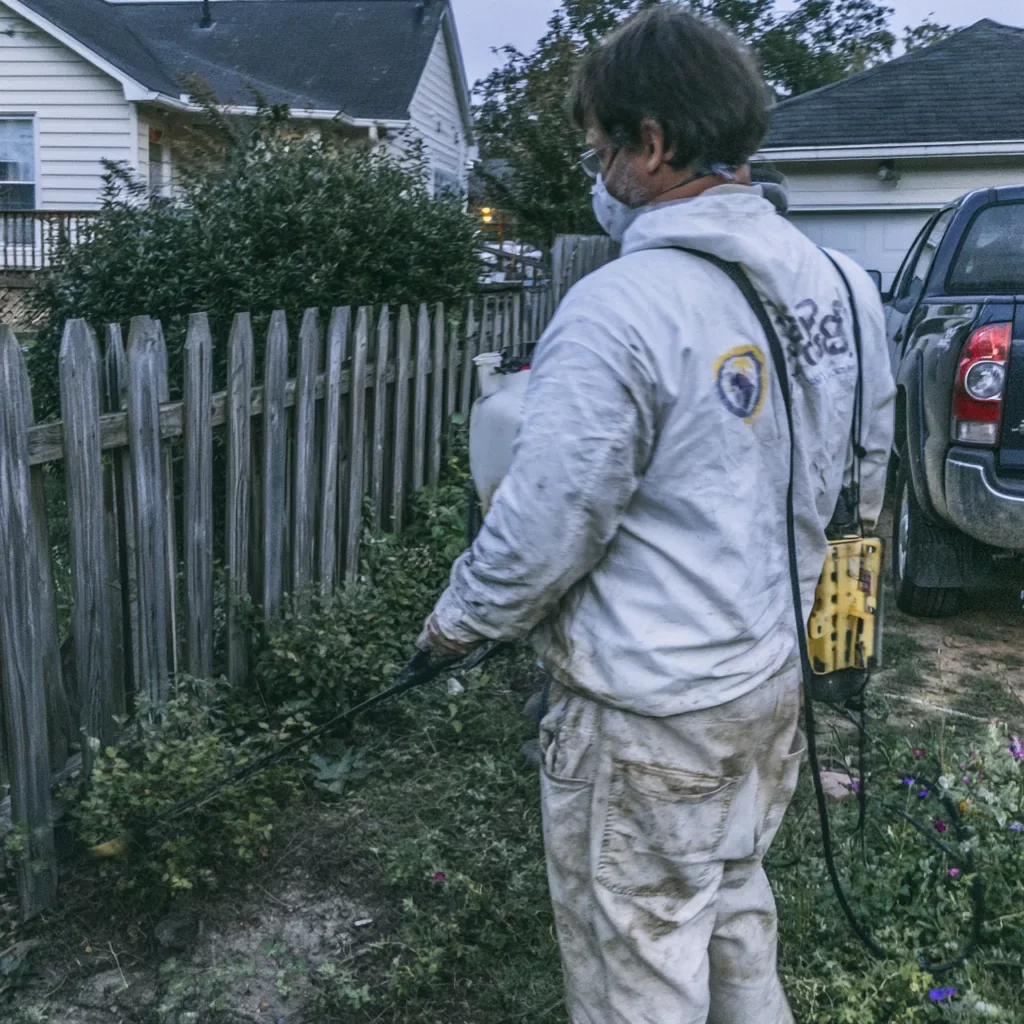
Attic Insulation Removal and Replacement in Mount Pleasant
What happens above the ceiling once the animals are out and the entry points are shut.
Attic insulation removal is the second half of a roof rat, squirrel or bat job, not an energy upgrade. Once animals have lived in the material it is compressed into runways, wet in places with urine, and carrying odor that reads to the next animal on the roofline as a den site that already worked. Contaminated material comes out, the entry points get sealed, and new insulation goes back to depth. Light activity confined to one or two bays can often be cleaned and treated where it lies.
Why contaminated insulation comes out instead of getting topped up
Insulation works by holding still air in place. Animal traffic flattens blown fiber into compacted runways, urine wets it, and either change alone lets heat move through it again. Laying a fresh layer over the top does not give back what the crushed material lost, and it seals the wet part underneath where it stays wet and keeps the framing above it damp.
The second reason is scent. Urine and droppings soak into fiber and stay there long after the animal has gone. To a roof rat working along a Mount Pleasant roofline — and roof rats are the species that does this here, not Norway rats — that smell reads as a den site that already worked. Shut the hole and leave the material, and the advertisement is still running for the next scout.
The third reason is timing. Dried droppings and contaminated fiber sit quietly for years until somebody moves a storage box, an HVAC technician services the air handler that sits up there in most Lowcountry houses, or a contractor pulls cable across a joist. Then the dust is airborne in a small unventilated space. Dealing with it once, on purpose, with filtration and protection, is easier than meeting it by accident later.
Roofline age plays into this as much as location does, and Mount Pleasant's older stock sits alongside newer builds in a way that West Ashley's Avondale section knows well too, where post-war ranch houses got attic upgrades decades after original construction. The licensed pros we connect you with treat a contaminated batt the same whether the house sits near Sam Rittenberg Boulevard or closer to the harbor: age and access matter more than which side of the Ashley River the ladder goes up on.
How a removal actually runs in a Lowcountry attic
The work runs off a hose rather than a shovel. A vacuum unit stands outside with hose fed in through a gable vent, a window or the hatch, and loose fill is drawn out into sealed bags or a filtered collection unit. Batts are rolled, bagged by hand and carried out along a covered route through the house.
Nesting material, food caches and heavy droppings come out by hand first, before anything else is disturbed. A vacuum hose driven straight into a nest puts far more into the air than lifting it out does. Crew work in P100 respiratory protection and disposable coveralls throughout, and the route from the hatch to the door is sheeted before the first bag moves.
Once the deck is clear, joist bays, top plates and sheathing are cleaned down and treated with an enzyme product that breaks the organic compounds apart rather than covering them. Entry points are confirmed sealed in hard materials before any new material goes in — insulating over an open hole simply hides it.
Heat sets the schedule here in a way it does not further north. A Mount Pleasant attic in July regularly passes 130°F by late morning. Removal work is booked for early starts and run in shifts, which is why a job that sounds like a day often runs across two.
Attic access itself shapes the sequence in Mount Pleasant just as much as the heat does. In Snee Farm, homes tucked under mature live oak canopy off Whipple Road often have less roof ventilation than newer builds, trapping heat further and pushing crews toward that early start. Down in the Old Village, older attics near Pitt Street Bridge and Coleman Boulevard tend to have tighter joist spacing, so removal moves in smaller loads, vacuumed out rather than shoveled, before fresh insulation goes back in the same afternoon.
When cleaning in place is the honest answer
Not every contaminated attic needs stripping. Where activity was recent and confined, droppings sit on the surface rather than through the depth of the material, there is no urine staining on the deck and the fiber is still lofted, cleaning and treating in place is reasonable and considerably cheaper.
The tell that removal is the right call is usually smell rather than sight. If loose debris is out, surfaces have been treated, and the odor comes back as soon as the attic heats up in the afternoon, the material itself is holding it and no amount of surface work will change that.
An operator who inspects the attic and tells you it is a clean-and-treat rather than a removal is giving you the more useful answer, not the cheaper one. Ask to be shown photographs of what they are looking at before you agree either way.
Attic access itself sets the terms out toward Dunes West, where raised and pier-built homes near Wagner Creek and the Wando River marsh frontage often trap humid air against old batt insulation long before a homeowner notices sagging paper backing. Farther up Highway 41, closer to the tidal salt marsh, the same moisture problem shows up in ductwork runs rather than the insulation itself, which is exactly why the pros we connect you with in Mount Pleasant photograph both before recommending which one to redo.
| Consideration | Clean and treat in place | Remove and replace |
|---|---|---|
| When it applies | Recent activity in one or two bays, droppings sitting on the surface, no urine staining on the deck, material still lofted | Contamination through the depth of the material, staining on the deck, matted runways, long or repeated occupation, or odor that returns once the attic heats up |
| What is done | Debris and droppings lifted out, surfaces cleaned and treated, affected patches replaced | Removal under vacuum, deck and framing cleaned and treated, new material installed to an even depth |
| Typical duration | Half a day to a day | One to two days depending on access and depth |
| What it does not fix | Odor held inside the body of the insulation, and R-value already lost to compression | Nothing, provided the entry points are sealed first |
| Sensible when | Budget matters and the contamination is genuinely light | There has been a colony, a long occupation, or the smell reaches the living space |
What goes back, and to what depth
Charleston County sits in climate zone 3A. The current recommendation for an unconditioned vented attic here is roughly R-38, which is about fourteen inches of blown fibreglass or a little under twelve of blown cellulose. A great many Mount Pleasant houses built before the mid-1990s were finished nearer R-19 and never upgraded, so a removal is often the only practical chance to correct that.
Depth has to be even. Blown material that drifts against the gable and thins over the middle of the ceiling performs to its thin point, not its average. Rafter-mounted depth markers left in place after the job are the simplest way to check the work on the day and to check it again in five years.
Soffit baffles matter more here than the choice between fibreglass and cellulose does. If blown material is allowed to bury the soffit vents the attic loses its intake air, moisture builds under the deck through a humid Lowcountry summer, and you have traded a rodent problem for a mold problem. Baffles hold that channel open.
Where the air handler and ductwork sit in the attic — which is the norm in this area — check the duct seals and the plenum while the deck is clear. It is the only time they will ever be easy to reach, and leaking return duct in a contaminated attic is how attic air ends up in the bedrooms.
Bats, and why the timing is not yours to choose
If the animal in the attic is a bat colony rather than rodents, the work is governed by more than preference. Bats are protected in South Carolina, and SC DNR guidance sets an exclusion window around the maternity season — broadly mid-May to the end of July — during which flightless pups would be sealed inside and die if the colony were excluded.
That means an attic with bat guano may have to wait, and a contractor who offers to seal it up in June is either unaware of the rule or ignoring it. Either one is a reason to call somebody else.
Guano handling is also different from rodent droppings. It breaks down into fine dust very readily, it accumulates in far greater depth under a roost than rodents ever produce, and in a long-established colony it is heavy enough to load a ceiling. The clean-up is a bigger job and it should be scoped as one.
Insurance, and what is usually covered
Homeowner policies in South Carolina generally treat gradual animal damage as maintenance rather than a covered peril, which means the contamination itself is often not claimable. What is more likely to be covered is sudden consequential damage — a ceiling that comes down under the weight of a saturated area, or wiring damage that leads to a further loss.
Photograph the attic before anything is touched, from several angles, including the entry point from outside. That documentation costs nothing and is frequently the difference between a claim that gets assessed and one that is declined for lack of evidence.
Keep the operator's written scope and the disposal record. If you sell the house later, being able to show that a contaminated attic was properly remediated is worth considerably more than a verbal assurance to a buyer's inspector.
What an attic insulation removal usually includes
- An attic inspection identifying the species, every entry point, and how deep the contamination runs
- Floor protection laid from the hatch out to the door, with the work area shut off from the rest of the house
- Hand removal of nesting material, food caches and heavy droppings before any vacuum work starts
- Vacuum removal of loose fill into sealed bags or a filtered collection unit
- Cleaning and enzyme treatment of the deck, joist bays and top plates once it is clear
- Written confirmation that entry points are sealed in hard materials before new material goes down
- New insulation installed to an even depth with soffit baffles left clear for intake air
Frequently Asked Questions
Can I just lay new insulation over the top of it?
You can, and it is the most common shortcut, but it buries the problem instead of fixing it. Compressed and wetted material underneath keeps performing badly, the odor stays in the building and moves down into the living space through recessed lights and the attic hatch, and everything you cover becomes dust for the next person who works up there. Where the old layer is dry, lofted and clean, adding to it is perfectly reasonable. Where an animal has lived in it, it is not.
How long does a full removal take?
A typical Mount Pleasant attic of 1,500 to 2,500 square feet runs one to two days, depending on access, the depth of material and how far the contamination spread. Summer heat shortens the working day considerably — an attic here passes 130°F by late morning in July — so a job quoted as a day in February may genuinely take two in August.
Does the attic have to be treated before new insulation goes in?
Yes. New material laid over contaminated framing picks the odor straight back up, and within a season you are smelling the same thing through a fresh layer. Surfaces need to be cleaned, treated and dry before anything new is installed.
Will removing the insulation get rid of the smell completely?
In most cases yes, provided three things happen: the contaminated material comes out rather than getting covered, the framing is treated with an enzyme product rather than a masking deodoriser, and the entry points are sealed so nothing re-marks the space. Where urine has soaked deeply into old sheathing a second application is sometimes needed, and a reasonable operator will come back and do it.
Is this an energy job or a pest job?
It is a pest job with an energy benefit attached. The reason for doing it is contamination and odor; the R-value improvement is a genuine bonus, especially on an older Mount Pleasant house insulated to 1980s standards and never upgraded since. If someone is selling you attic insulation removal purely on energy savings with no animal problem behind it, treat that with caution.
Get the attic looked at before you re-insulate it
If something has been living up there, the insulation question comes after the sealing question. Call and we will connect you with a licensed local pro who will inspect the attic, tell you honestly whether it is a clean-up or a removal, and price the work after they have seen it.
Call (843) 868-3211